
Replacing forms are the strongest type of respectful verb. This makes them particularly useful and important in formal contexts and when discussing the actions of those higher in social status. Special attention needs to be paid to the new respectful verb and the plain verb, or verbs, whose core meaning they replace. The following six replacing form verbs are the most common. I recommend learning to understand and use these six verbs and acquiring the less common replacing form verbs over time.
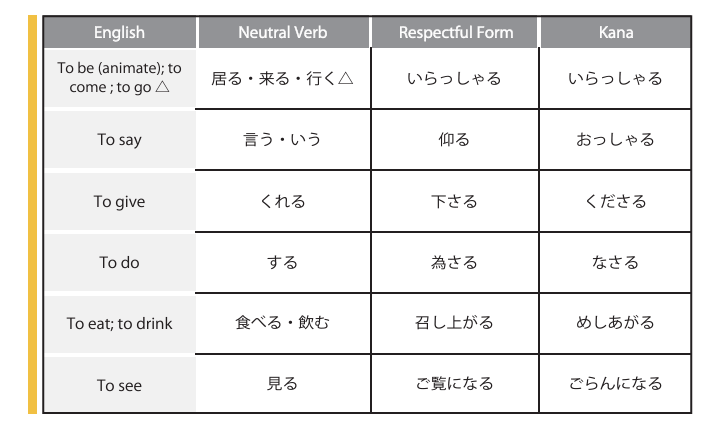
The first two verbs are without a doubt the most commonly encountered. ossharu おっしゃる and kudasaru くださる are nice and easy as they only replace one verb iu 言う (“to say”) and kureru くれる (“to give”) respectively. A little bit trickier is irassharu いらっしゃる, displaying a trait found in a number of replacing form verbs: replacing more than one plain verb.
| irassharu | |
| Potential Core Meanings | kuru 来る (“to come”) |
| iru いる (“to be” – animate) | |
| iku 行く (“to go”) | |
| Expressive Meaning | the speaker creates vertical distance with Ms. Tanaka |
Which meaning is implied depends on the context, an ambiguity that contributes to the respect implied by the honorific form. While it is important to know that irassharu has three potential meanings, in reality it is mostly used for the first two meanings, iru (“to exist”) and kuru (“to come”). Although, you might occasionally here irassharu used in the sense of iku (“to go”) the (ra)reru form ikareru is more common.
The next three are also important, although they definitely appear less frequently. nasaru なさる and goran ni naru ご覧になる only replace one plain verb, suru する (“to do”) and miru 見る (“to see”) respectively. The last verb, meshiagaru 召し上がる replaces two verbs: taberu 食べる (“to eat”) and nomu 飲む (“to drink”).
| meshiagaru | |
| Potential Prepositional Meanings | taberu 食べる (“to eat”) |
| nomu 飲む (“to drink”) | |
| Expressive Meaning | the speaker creates vertical distance |
 Kotobakun